Recommended Reads

Here are some recommended books on Thomas Jefferson
and Religious Freedom with Amazon links below:

Religious Freedom: Jefferson’s Legacy, America’s Creed
The VA Statute for Religious Freedom: Its Evolution and Consequences
Endowed by Our Creator: The Birth of Religious Freedom in America
Thomas Jefferson and the Virginia Statute for Religious Freedom
Establishing Religious Freedom: Jefferson’s Statute in Virginia
Thomas Jefferson’s Bible: Religious Freedom in America
The Religious Life of Thomas Jefferson
Thomas Jefferson’s Qur’an: Islam and the Founders

Separation of church and state

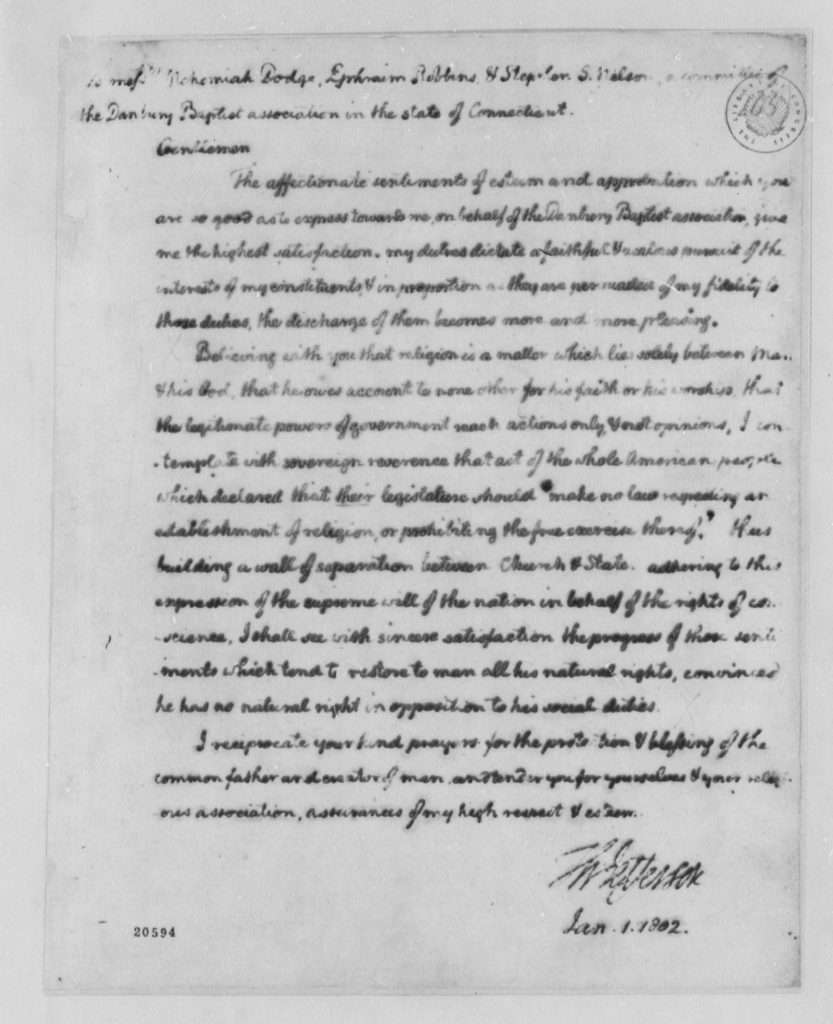
Contrary to popular belief, the term “separation of church and state” does not appear anywhere in the Virginia Statute for Religious Freedom. Thomas Jefferson’s reply to the Danbury Baptists Association in the State of Connecticut, was the first appearance of that statement:

Thomas Jefferson’s letter to the Danbury Baptist Association:

To messers. Nehemiah Dodge, Ephraim Robbins, & Stephen S. Nelson, a committee of the Danbury Baptist association in the state of Connecticut.

Gentlemen, The affectionate sentiments of esteem and approbation which you are so good as to express towards me, on behalf of the Danbury Baptist association, give me the highest satisfaction. My duties dictate a faithful and zealous pursuit of the interests of my constituents, & in proportion as they are ersuaded of my fidelity to those duties, the discharge of them becomes more and more pleasing. Believing with you that religion is a matter which lies solely between Man & his God, that he owes account to none other for his faith or his worship, that the legitimate powers of government reach actions only, & not opinions, I contemplate with sovereign reverence that act of the whole American people which declared that their legislature should ʺmake no law respecting an establishment of religion, or prohibiting the free exercise thereof,ʺ thus building a wall of separation between Church & State. Adhering to this expression of the supreme will of the nation in behalf of the rights of conscience, I shall see with sincere satisfaction the progress of those sentiments which tend to restore to man all his natural rights, convinced he has no natural right in opposition to his social duties. I reciprocate your kind prayers for the protection & blessing of the common father and creator of man, and tender you for yourselves & your religious association, assurances of my high respect & esteem.

Th: Jefferson
Jan. 1. 1802
A daughter’s memory

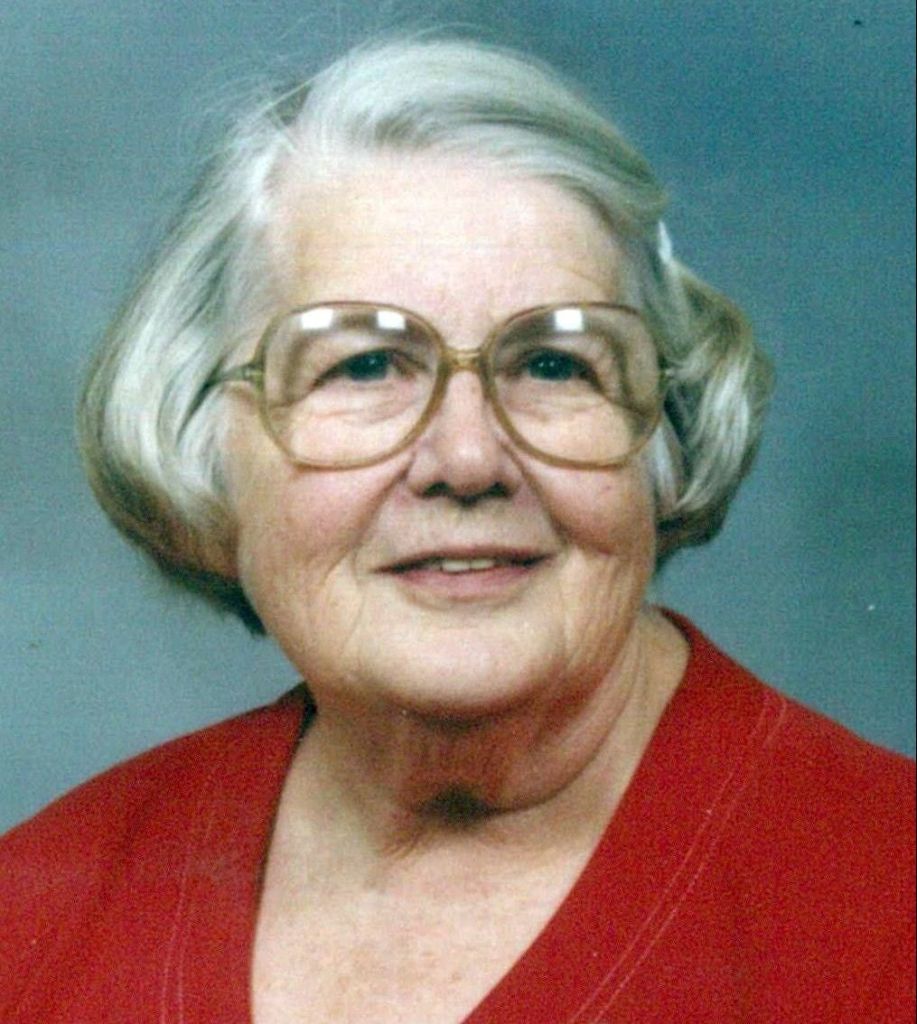
St Clair Brooks’ daughter, Marion, was still teaching Sunday School at Falmouth Baptist Church when the monument her father took her to see in 1932, when she was almost seven, was moved to Washington Avenue.

She told me: “He said it was important since it wasn’t just about freedom to worship as you choose, but that it wasn’t anyone else’s business”. I told Marion her father must have thought she was pretty smart. She replied “He did!” Marion Brooks Robinson died age 92, March 28, 2018.

Religious Freedom Day

First established by the Thomas Jefferson Institute for the Study of Religious Freedom during the 1976 U.S. bicentennial and later assumed by the Knights of Columbus Rappahannock Assembly 1613, the city has come together to commemorate the bill and Jefferson’s role in preserving religious freedom in a ceremony for all faiths at the Religious Freedom Monument on Washington Avenue. The event is attended by more than one hundred participants. The appropriate ceremony includes a parade, the laying of a wreath, a benediction and a keynote speech.

Often, the parade is led by the Knights of Columbus, followed by groups such as members of the Church of Jesus Christ of Latter-day Saints, the Lutheran Church and members of the local Masonic lodge. Members of all faiths are invited to carry a banner identifying their affiliation and showing support for religious freedom.

The event symbolizes the healthy dialogue and relationships that exist between the city’s different religious groups. Each year, the mayor of Fredericksburg issues an official proclamation recognizing the statute.

Proclamation example:

Whereas, It was in the Town of Fredericksburg, in the month of January 1777, that Thomas Jefferson first presented his Statute for Religious Freedom to a committee of revisors of the Laws of Virginia to make them conform in letter and spirit to the Declaration of Independence: and Whereas, the Statute was passed January 16, 1786, by the Virginia General Assembly and in March 1789 became the basis for the First Amendment to the Constitution of the United States of America: and Whereas, still in force, the Statute as the most liberal in the world, guarantees to every citizen freedom of belief and expression, and has since inspired millions of people everywhere: and Whereas, recognizing the importance of this document in view of the current secular and religious discussions, and carrying out the desire of its author that what he had done for the people be duly remembered. Now, therefore, I, Lawrence A. Davies, Mayor of the City of Fredericksburg, Virginia, do hereby proclaim this day as Religious Freedom Day.

Moving the Monument

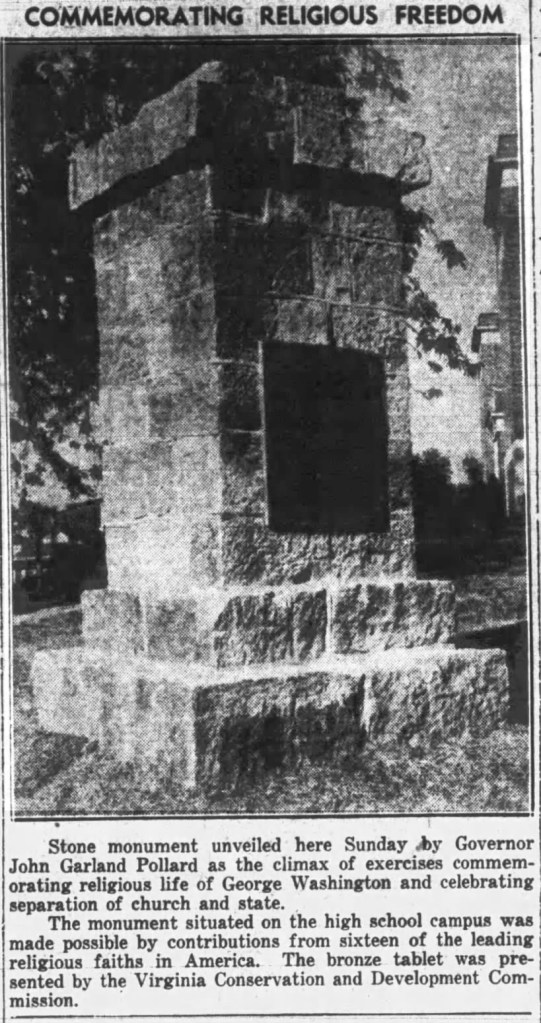
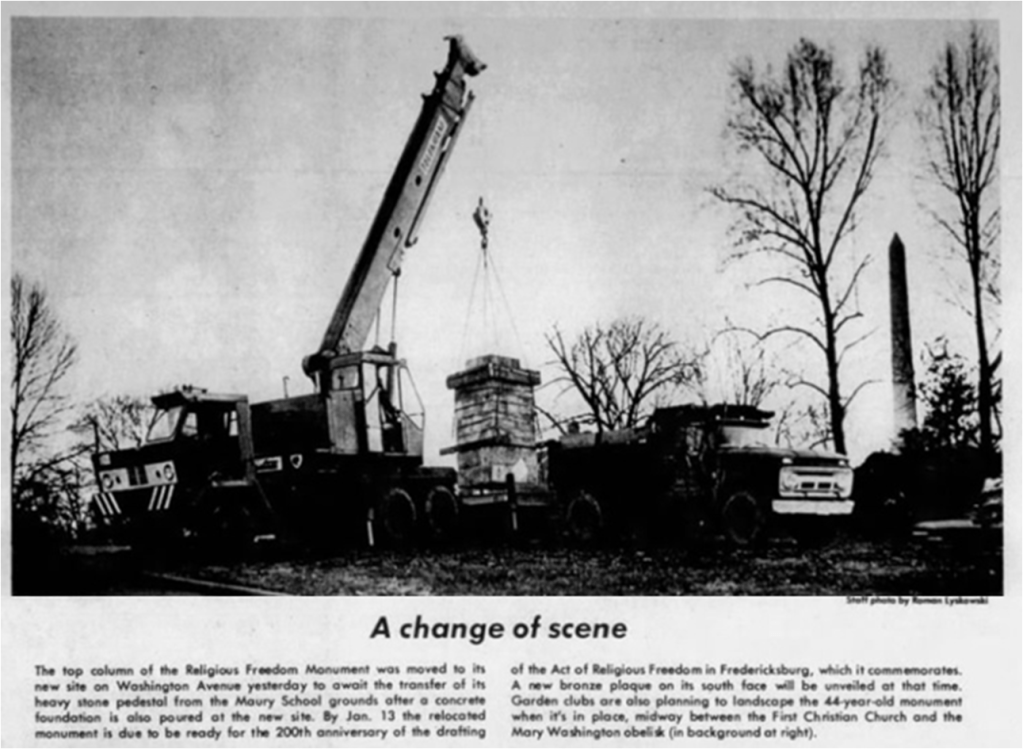
The Religious Freedom Monument was originally installed on George Street, but it was later moved to its present location on Washington Avenue. This area is a historical district within the city. It is located on the original grounds of Kenmore Plantation, just steps from the mansion on a small, beautiful, secluded parkway that also holds the Mary Washington and General Hugh Mercer Monuments. The Washington Avenue Historic District is Fredericksburg’s only historic monumental avenue and the site of high-style residences built for the city’s elite at the turn of the twentieth century. The new location was more fitting for the monument, as it was now among other noteworthy tributes. You can read more about the monument here.

Pic: The Free Lance-Star 12/3/76

Jefferson’s Contribution

Prior to his death Thomas Jefferson left behind specific instructions for the obelisk monument that was to mark his grave. In addition to sketching out the exact size and shape of the stone he requested the following epitaph:

Here was buried
Thomas Jefferson
Author of the Declaration of American Independence
of the Statute of Virginia for Religious Freedom
and Father of the University of Virginia

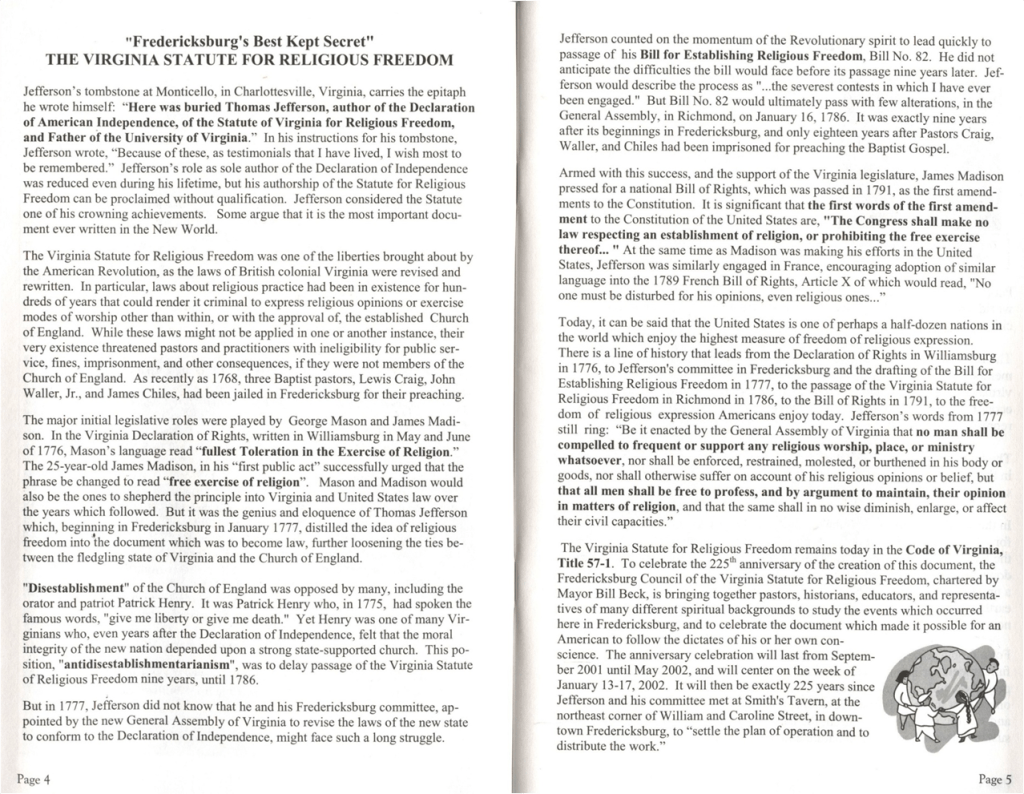
These contributions were in his words the “testimonials that I have lived, I wish most to be remembered.” It is curious that with all his contributions, such as the political offices he held, (President of the United States being one), he selected these three specific memories. Author of the Declaration of American Independence is obvious, Father of the University of Virginia is understandable, but the astonishing choice is the author of the Statute of Virginia for Religious Freedom (now commonly referred to as the Virginia Statute for Religious Freedom). Not that this is unimportant. but of all his achievements this one is often overlooked.

Jefferson crafted this statute, not in Philadelphia or one of the other busy cities of the day. He wrote it while staying in a small Virginia town on the Rappahannock River named Fredericksburg. Jefferson often passed through the town on his journeys to and from Monticello. Jefferson was a second cousin of Ann Randolph Fitzhugh and a good friend of William Fitzhugh, the builders of one of the town’s estates called Chatham.

In 1777, Jefferson stayed at Weedon’s Tavern (known as Smith’s at the time) in Fredericksburg where he penned the actual life-altering document. It established the right of every man and woman to their own religious beliefs and opinions. The Virginia General Assembly passed the landmark statute in 1786. And in 1789, it became the basis for the First Amendment to the United States Constitution.

The event not only had a lasting effect on the country, it more specifically had a permanent effect on the city where the proposition was written. In 1932, the Fredericksburg City Council commissioned St Clair Brooks, a stonemason, to erect a monument commemorating Jefferson’s bill. Today it is one of the city’s most treasured monuments. Each year in January the Religious Freedom Day parade hits the streets of downtown Fredericksburg to commemorate the anniversary of Jefferson drafting the statute. Special events also take place in the weeks leading up to the parade.

Who are we?

Featured

In 1974 Fredericksburg, Virginia, Dr. Kurt F. Leidecker established the Thomas Jefferson Institute for the Study of Religious Freedom, which was active until his death in 1991. In 2001, our group was formed to continue Dr. Leidecker’s legacy, and to call attention to the 225th anniversary of Jefferson’s Bill for Establishing Religious Freedom. In 2026, we reactivated as the Alliance for the 250thanniversary of the bill, and again to call attention to Fredericksburg as the place where Jefferson first outlined it in January 1777. Read Our Mission Statement Subscribe below to get updates.