Prior to his death Thomas Jefferson left behind specific instructions for the obelisk monument that was to mark his grave. In addition to sketching out the exact size and shape of the stone he requested the following epitaph:
Here was buried
Thomas Jefferson
Author of the Declaration of American Independence
of the Statute of Virginia for Religious Freedom
and Father of the University of Virginia
These contributions were in his words the “testimonials that I have lived, I wish most to be remembered.” It is curious that with all his contributions, such as the political offices he held, (President of the United States being one), he selected these three specific memories. Author of the Declaration of American Independence is obvious, Father of the University of Virginia is understandable, but the astonishing choice is the author of the Statute of Virginia for Religious Freedom (now commonly referred to as the Virginia Statute for Religious Freedom). Not that this is unimportant. but of all his achievements this one is often overlooked.
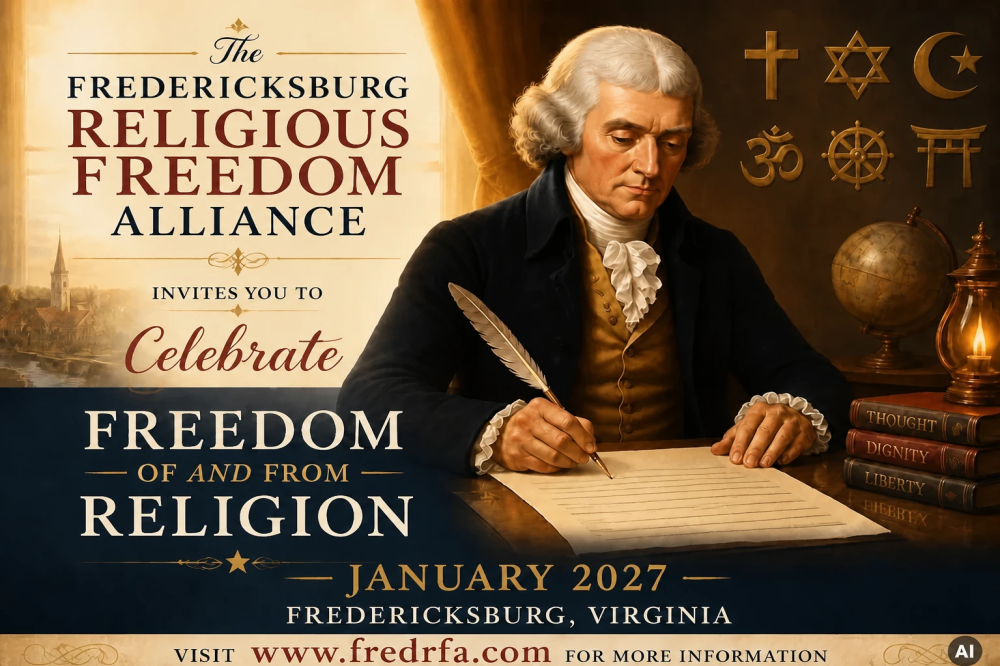
Jefferson crafted this statute, not in Philadelphia or one of the other busy cities of the day. He wrote it while staying in a small Virginia town on the Rappahannock River named Fredericksburg. Jefferson often passed through the town on his journeys to and from Monticello. Jefferson was a second cousin of Ann Randolph Fitzhugh and a good friend of William Fitzhugh, the builders of one of the town’s estates called Chatham.
In 1777, Jefferson stayed at Weedon’s Tavern (known as Smith’s at the time) in Fredericksburg where he penned the actual life-altering document. It established the right of every man and woman to their own religious beliefs and opinions. The Virginia General Assembly passed the landmark statute in 1786. And in 1789, it became the basis for the First Amendment to the United States Constitution.
The event not only had a lasting effect on the country, it more specifically had a permanent effect on the city where the proposition was written. In 1932, the Fredericksburg City Council commissioned St Clair Brooks, a stonemason, to erect a monument commemorating Jefferson’s bill. Today it is one of the city’s most treasured monuments. Each year in January the Religious Freedom Day parade hits the streets of downtown Fredericksburg to commemorate the anniversary of Jefferson drafting the statute. Special events also take place in the weeks leading up to the parade.

