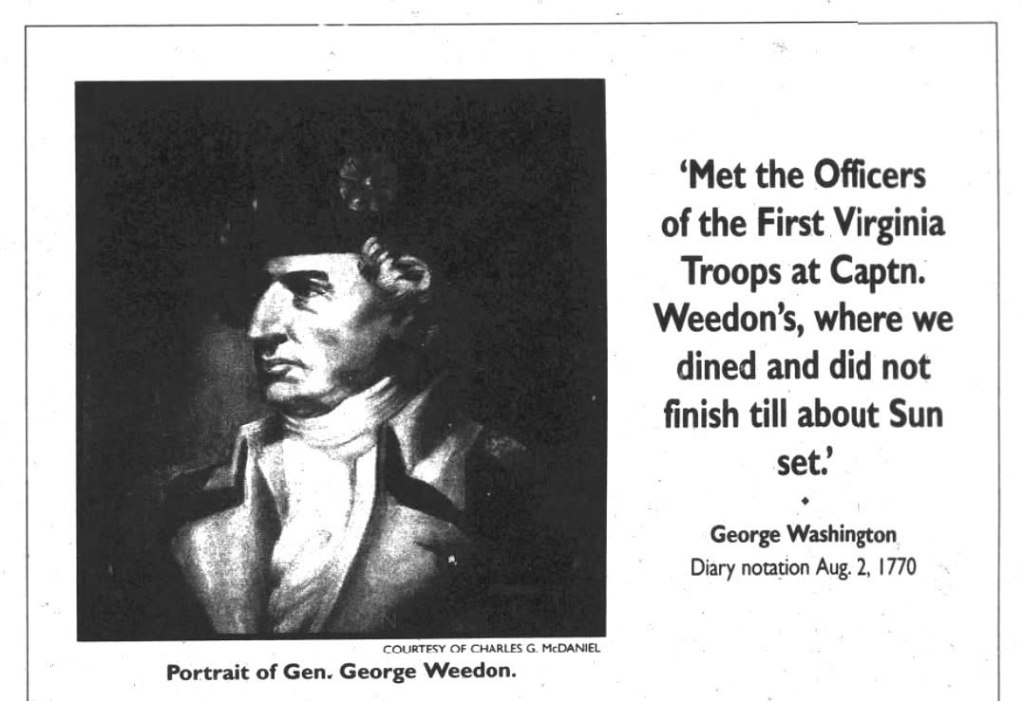
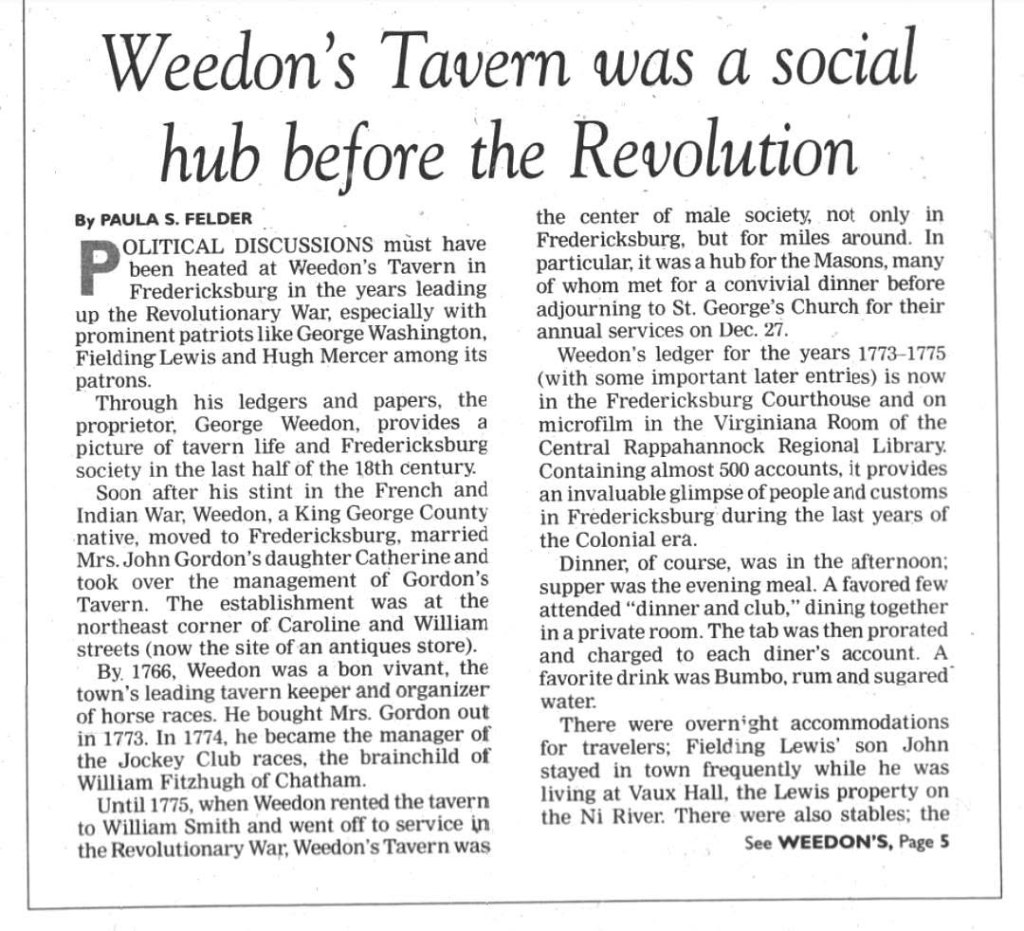
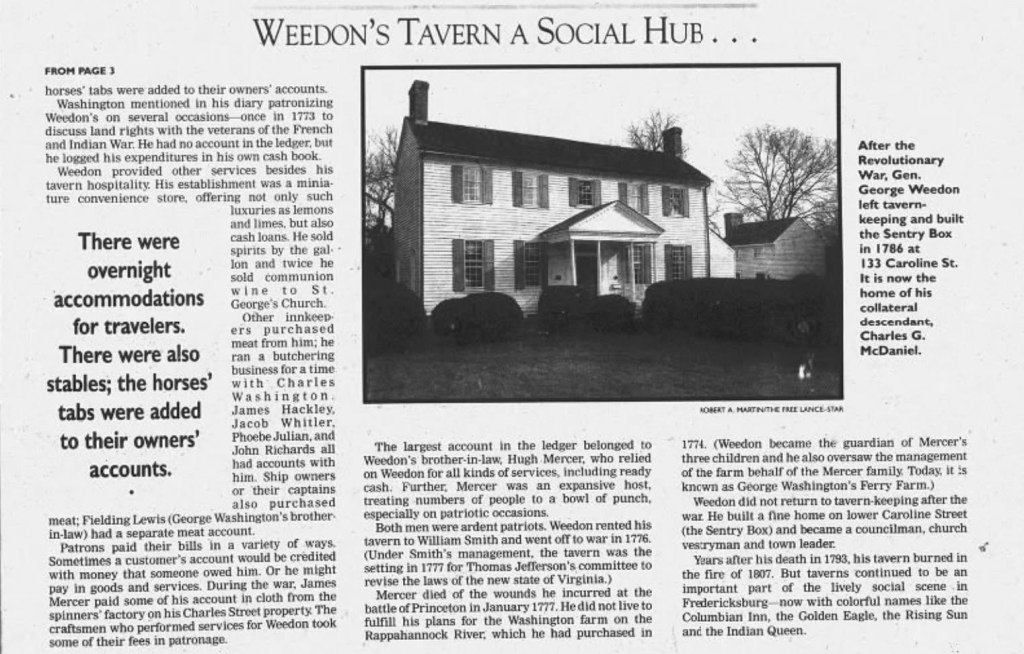
This FLS article appeared on Monday January 14, 1974.

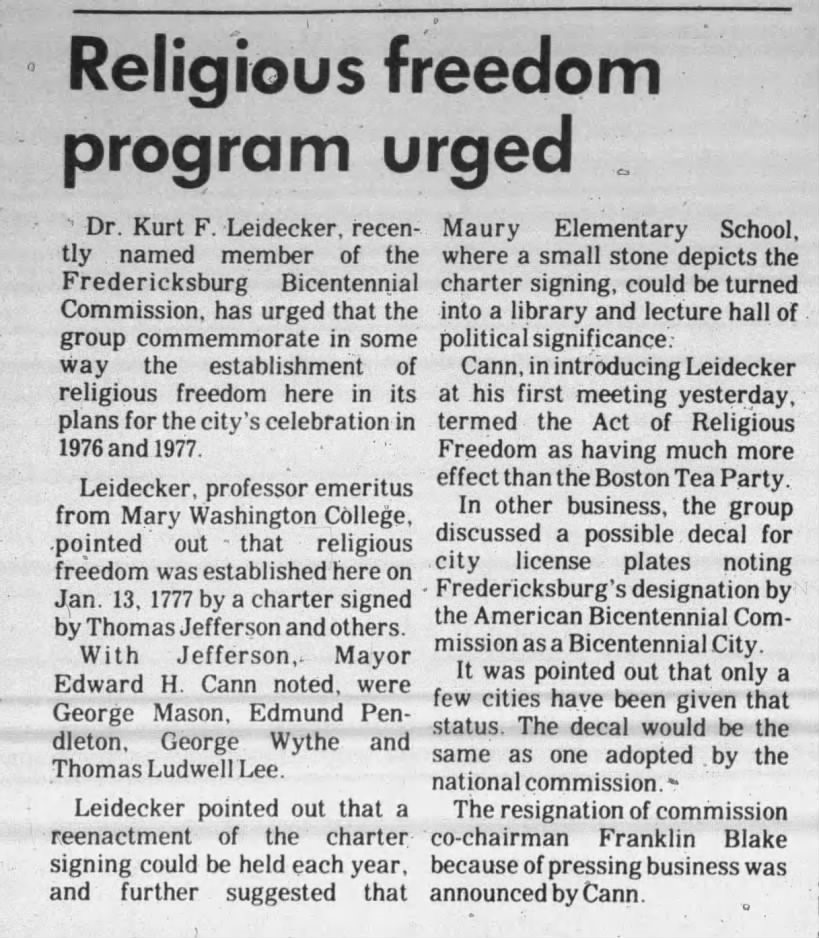
This FLS article appeared on Monday January 14, 1974.

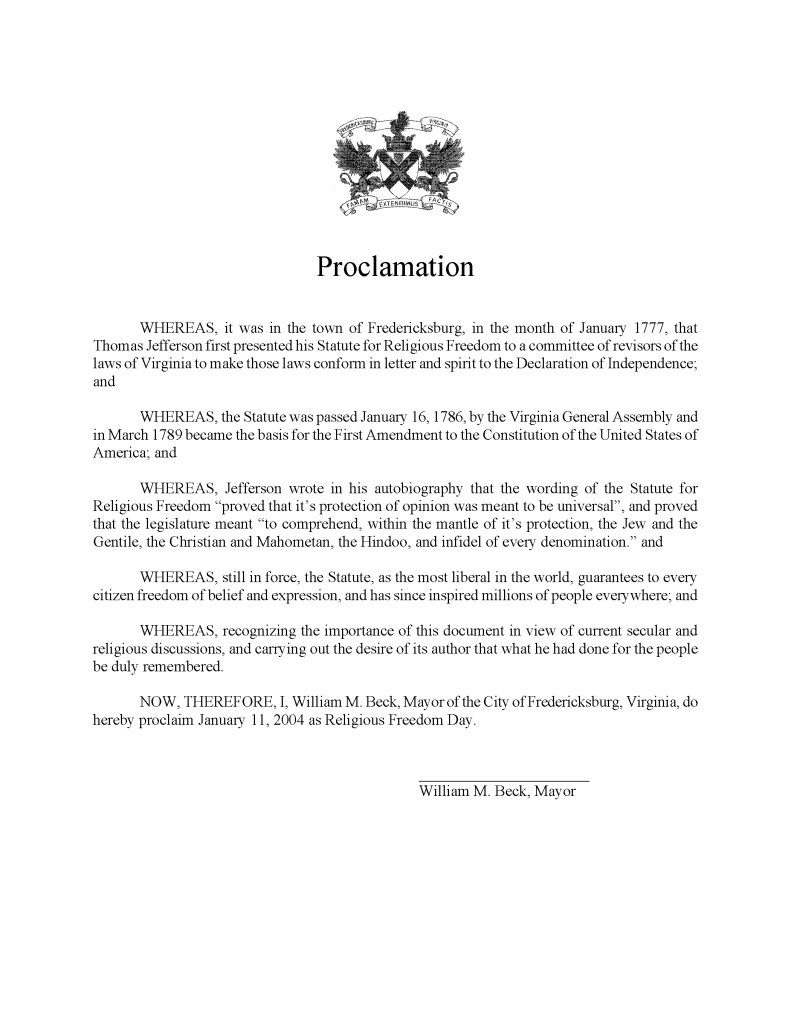
Former Fredericksburg City Mayor and Fredericksburg Religious Freedom Alliance member Bill Beck’s January 11, 2004 Proclamation

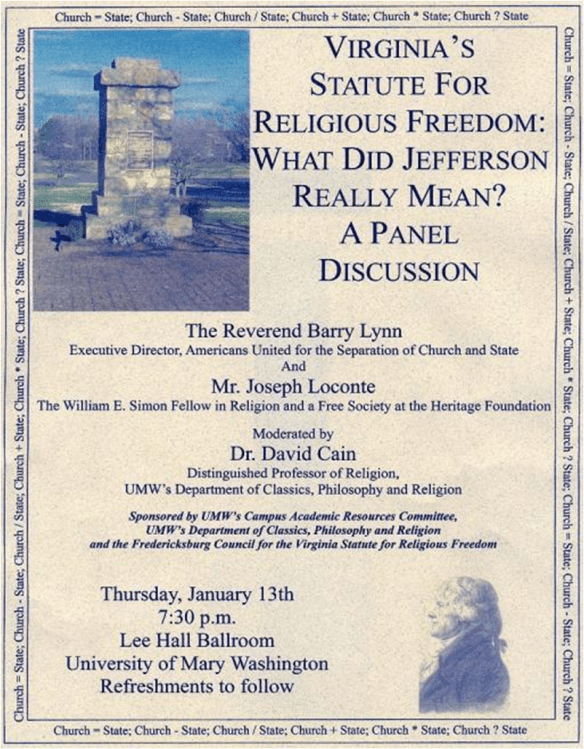
2005 Panel Discussion
We now have a Facebook page at: https://www.facebook.com/FCVSRF/
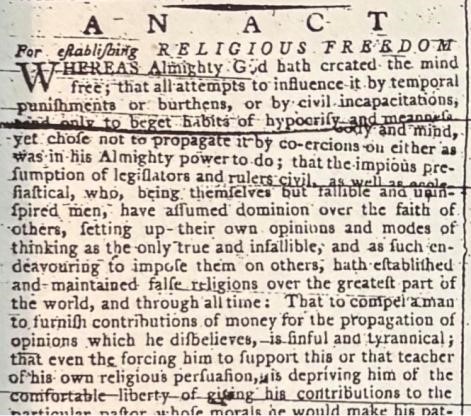
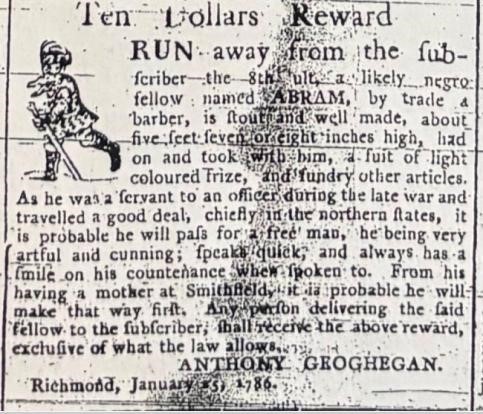
Virginia Gazette and Independent Chronicle (January 26, 1786, Richmond) announcing AN ACT For establishing RELIGIOUS FREEDOM adjacent to “Ten Dollars Reward for RUN away fellow named ABRAM…”


Monument repair work is underway at the Religious Freedom Monument. Abby Construction completed cleaning earlier this week, which took place from Monday, June 8 through Wednesday, June 10. Additional work, including mortar repointing and bronze plaque cleaning, will follow. Work is expected to continue over the coming days, weather and scheduling permitting, and should take approximately one week to complete.

Thomas Jefferson rejected the “divinity” of Jesus, but he believed that Christ was a deeply interesting and profoundly important moral or ethical teacher. He also subscribed to the belief that it was in Christ’s moral and ethical teachings that a civilized society should be conducted. Cynical of the miracle accounts in the New Testament, Jefferson was convinced that the authentic words of Jesus had been contaminated.
In 1820 he conducted what practicing Christians consider to be blasphemy. He completed an ambitious work titled “The Life and Morals of Jesus of Nazareth Extracted Textually from the Gospels in Greek, Latin, French and English.”
Using a razor and glue, Jefferson cut and pasted his arrangement of selected verses from a 1794 bilingual Latin/Greek version using the text of the Plantin Polyglot, a French Geneva Bible and the King James Version of the gospels of Matthew, Mark, Luke, and John in chronological order—putting together excerpts from one text with those of another to create a single narrative.
The text of the New Testament appears in four parallel columns in four languages. Jefferson omitted the words that he thought were inauthentic and retained those he believed were original. The resulting work is commonly known as the “Jefferson Bible.”
No supernatural acts of Christ are included. Jefferson viewed Jesus as strictly human. He also believed that Jesus Himself ascribed to a more deistic belief system. In a letter to Benjamin Rush, he wrote: “I should proceed to a view of the life, character, and doctrines of Jesus, who sensible of incorrectness of their ideas of the Deity, and of morality, endeavored to bring them to the principles of a pure deism.” (April 9, 1803).
Jefferson also completely denied the resurrection. The book ends with the words: “Now, in the place where He was crucified, there was a garden; and in the garden a new sepulchre, wherein was never man yet laid. There laid they Jesus. And rolled a great stone to the door of the sepulchre, and departed.”
Jefferson described the work in a letter to John Adams dated October 12, 1813: “In extracting the pure principles which he taught, we should have to strip off the artificial vestments in which they have been muffled by priests, who have travestied them into various forms, as instruments of riches and power to them…We must reduce our volume to the simple evangelists, select, even from them, the very words only of Jesus…There will be found remaining the most sublime and benevolent code of morals which has ever been offered to man. I have performed this operation for my own use, by cutting verse by verse out of the printed book, and arranging the matter which is evidently his, and which is as easily distinguishable as diamonds in a dunghill. The result is an 8vo of 46 pages of pure and unsophisticated doctrines.”
In a letter to Reverend Charles Clay, he described his results: “Probably you have heard me say I had taken the four Evangelists, had cut out from them every text they had recorded of the moral precepts of Jesus, and arranged them in a certain order; and although they appeared but as fragments, yet fragments of the most sublime edifice of morality which had ever been exhibited to man.”
Most historians feel that Jefferson composed the book for his own satisfaction, supporting the Christian faith as he saw it. He did not produce it to shock or offend the religious community; he composed it for himself, for his devotion, and for his own personal assurance.
After completion of the Life and Morals, about 1820, Jefferson shared it with a number of friends, but he never allowed it to be published during his lifetime. The most complete form Jefferson produced was inherited by his grandson, Thomas Jefferson Randolph.

In 1986, the Thomas Jefferson Institute sold “freedom medals” to commemorate the two hundredth anniversary of the Virginia Statute for Religious Freedom. The bronze medals were designed locally and sold for twenty dollars. Designed by Scott Howson, they were cast by Wegner Metal Arts, where a twenty-five-step process was required to create them.
About three inches in diameter, one side depicted the likeness of Jefferson, while the other depicted the dates he drafted the statute in Fredericksburg. Dr. Leidecker said that they had originally petitioned Congress to issue the medal in 1977, which was the actual two hundredth anniversary of the drafting of the statute. Unfortunately, they denied the request. Leidecker remained dedicated to the project, and all those years later, he finally saw his efforts come to fruition. “We celebrate people,” he said in an interview with the Free Lance-Star. “Why not celebrate their ideas?”
Jefferson’s time in Fredericksburg in 1777 resulted in one of the most significant documents ever put forth in the annals of this country’s history. His selection of the small yet bustling town on the banks of the Rappahannock River says much for its welcoming atmosphere. The January days the committee spent at the tavern, contemplating the fulfillment of their task while taking time to enjoy their surroundings, says much for the hospitality of the town. The fact that Jefferson was a visitor on more than one occasion reinforces his affinity for the city and its people. The legacy he left behind, as part of the city’s history, is both remarkable and memorable.
The following is a timeline of events:
June 12, 1776: The Virginia Convention adopts the Declaration of Rights, including the sixteenth article, which guarantees citizens the “free exercise of religion.”
October 1776–December 1776: Thomas Jefferson and James Madison successfully advocate for “an act for exempting the different societies of Dissenters from contributing to the support and maintenance of the church as by law established, and its ministers, and for other purposes therein mentioned.”
January 13–17, 1777: Thomas Jefferson travels to Fredericksburg and drafts a bill “for establishing religious freedom” as part of an effort to revise Virginia’s colonial laws in order to remove vestiges of monarchy and align them more closely with the state’s republican principles and its new independent status.
June 12, 1779: Because Thomas Jefferson had since been elected governor, John Harvie introduces Jefferson’s bill “for establishing religious freedom” to the House of Delegates. It is eventually tabled.
November 11, 1784: The House of Delegates adopts a resolution supporting “a moderate tax or contribution, annually” to benefit all Christian sects. The resolution eventually fails.
June 20, 1785: James Madison anonymously authors his Memorial and Remonstrance Against Religious Assessments, a broadside in opposition to a resolution by the House of Delegates to levy a general assessment to benefit all Christian sects.
October 31, 1785: James Madison reintroduces to the House of Burgesses 117 bills from an earlier effort to revise Virginia’s laws. Among these is Thomas Jefferson’s bill “for establishing religious freedom.”
January 16, 1786: The general assembly passes the Bill for Establishing Religious Freedom. Written by Thomas Jefferson and championed in the House of Delegates by James Madison, the bill effectively severs the connection between church and state.

The Christian Bible was not the only religious tome to experience Thomas Jefferson’s examination. His vast collection of books contained many on religion. The Virginia Gazette, a newspaper from Williamsburg, served as a bookseller and sold Jefferson a two-volume set of the Quran in October of 1765.
It was titled “The Alcoran of Mohammed.” George Sale had translated it in 1734 from Arabic to English. In his introduction, Sale wrote that the purpose of the book was to help Protestants understand the Quran so that they could argue against it. He wrote:
“Whatever use an impartial version of the Korân may be of in other respects. It is absolutely necessary to undeceive those who, from the ignorant or unfair translations which have appeared, have entertained too favorable an opinion of the original, and also to enable us effectually to expose the imposture.”
Jefferson was 22 years-old and had studied law for three years when he obtained the book. Law professors of that time considered the Quran a book of law. Sale expanded on his motives:
“If the religious and civil Institutions of foreign nations are worth our knowledge, those of Mohammed, the lawgiver of the Arabians, and founder of an empire which in less than a century spread itself over a greater part of the world than the Romans were ever masters of, must needs be so.”
To them the Quran represented the ruling precepts of the Ottoman Empire, governing over 25 million people. Jefferson, as well as the Western world at that time, thought that the Quran was the chief representation of Islamic law. He is known to have studied the book, but it did not affect his practicing of law.
Jefferson carried the same anti-Islamic views of his colleagues. He did however, have the opinion that the Trinity and the humanness of Jesus were parallel in Islam. His experiences dealing with Islamic piracy in the Mediterranean Sea during his Presidency caused him to question Islam’s legitimacy as a religion.
In 1786, the United States found that it was having to deal directly with the doctrines of the Muslim religion. The Barbary states of North Africa were using the ports to wage a war of piracy and enslavement against all shipping that passed through the Strait of Gibraltar. Thousands of ships were overtaken, and more than a million Europeans and Americans were sold as slaves. Congress offered an agreement called the Treaty of Tripoli, negotiated by Jefferson, which stated roundly that “the government of the United States of America is not, in any sense, founded on the Christian religion, as it has in itself no character of enmity against the laws, religion or tranquility of Musselmen (Muslims).”
Many considered this to be a secular affirmation that attempted to buy off the Muslim pirates by the payment of tribute. Soon after it was discovered that Ambassador Sidi Haji Abdrahaman, Tripoli’s envoy to London, had extorted money and took slaves. Jefferson later reported to the Secretary of State and to Congress his motive was backed by his religious beliefs:
“The ambassador answered us that [the right] was founded on the Laws of the Prophet, that it was written in their Koran, that all nations who should not have answered their authority were sinners, that it was their right and duty to make war upon them wherever they could be found, and to make slaves of all they could take as prisoners, and that every Mussulman who should be slain in battle was sure to go to Paradise.”
Jefferson’s prejudice against Islam was questionable in some ways. He insisted on a constitution wherein “neither pagan nor Mahamedan (Muslim) nor Jew ought to be excluded from the civil rights of the Commonwealth because of his religion.” Still, to him and his contemporaries the idea of a Muslim president, or even a Muslim citizen, was an abstraction. The first American Muslims who traveled to the country, both free and enslaved, may have numbered in the tens of thousands, but at no time was true equality considered to be accessible.
That said, Jefferson did mention supporting religious freedom for Muslims in writings. He asserted in his autobiography that his original legislation for religious freedom had been intended “to comprehend, within the mantle of its protection, the Jew and the Gentile, the Christian and Mahometan [Muslim], the Hindoo, and Infidel of every denomination.”