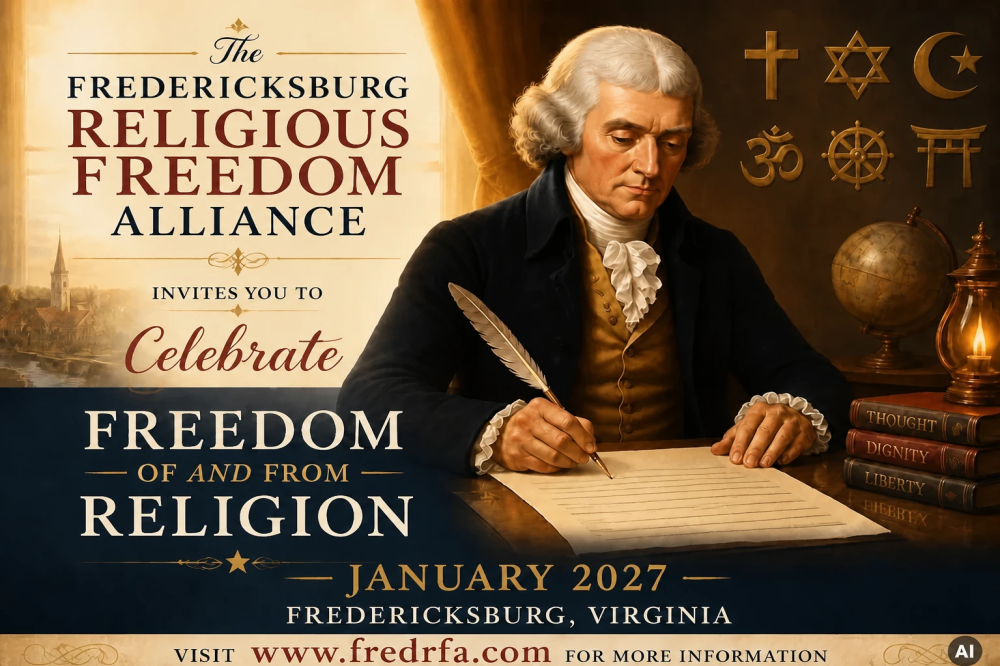
Jefferson’s time in Fredericksburg in 1777 resulted in one of the most significant documents ever put forth in the annals of this country’s history. His selection of the small yet bustling town on the banks of the Rappahannock River says much for its welcoming atmosphere. The January days the committee spent at the tavern, contemplating the fulfillment of their task while taking time to enjoy their surroundings, says much for the hospitality of the town. The fact that Jefferson was a visitor on more than one occasion reinforces his affinity for the city and its people. The legacy he left behind, as part of the city’s history, is both remarkable and memorable.
The following is a timeline of events:
June 12, 1776: The Virginia Convention adopts the Declaration of Rights, including the sixteenth article, which guarantees citizens the “free exercise of religion.”
October 1776–December 1776: Thomas Jefferson and James Madison successfully advocate for “an act for exempting the different societies of Dissenters from contributing to the support and maintenance of the church as by law established, and its ministers, and for other purposes therein mentioned.”
January 13–17, 1777: Thomas Jefferson travels to Fredericksburg and drafts a bill “for establishing religious freedom” as part of an effort to revise Virginia’s colonial laws in order to remove vestiges of monarchy and align them more closely with the state’s republican principles and its new independent status.
June 12, 1779: Because Thomas Jefferson had since been elected governor, John Harvie introduces Jefferson’s bill “for establishing religious freedom” to the House of Delegates. It is eventually tabled.
November 11, 1784: The House of Delegates adopts a resolution supporting “a moderate tax or contribution, annually” to benefit all Christian sects. The resolution eventually fails.
June 20, 1785: James Madison anonymously authors his Memorial and Remonstrance Against Religious Assessments, a broadside in opposition to a resolution by the House of Delegates to levy a general assessment to benefit all Christian sects.
October 31, 1785: James Madison reintroduces to the House of Burgesses 117 bills from an earlier effort to revise Virginia’s laws. Among these is Thomas Jefferson’s bill “for establishing religious freedom.”
January 16, 1786: The general assembly passes the Bill for Establishing Religious Freedom. Written by Thomas Jefferson and championed in the House of Delegates by James Madison, the bill effectively severs the connection between church and state.

